Being diagnosed with MND brings changes, challenges and extra considerations for a person living with the condition, as well as to their carers and families.
But the impact doesn’t stop there - this devastating condition not only drastically affects those directly experiencing it, the effects of MND are also felt across the wider
community.
In a report by MND Australia, Every Moment Matters: Addressing the human and economic toll of motor neurone disease in Australia, the wider-reaching impact of MND is revealed.
The report highlights the need for support for ALL experiencing MND, regardless of their age, and a national data registry to better inform MND research and care in Australia.
It also calls for the development of a national directory of expert MND healthcare professionals funded by the government, as well as a national MND support program for people living with MND and their carers.
Another key recommendation was the development and implementation of consistent definitions and practices for terminal illness in superannuation and life insurance policies.
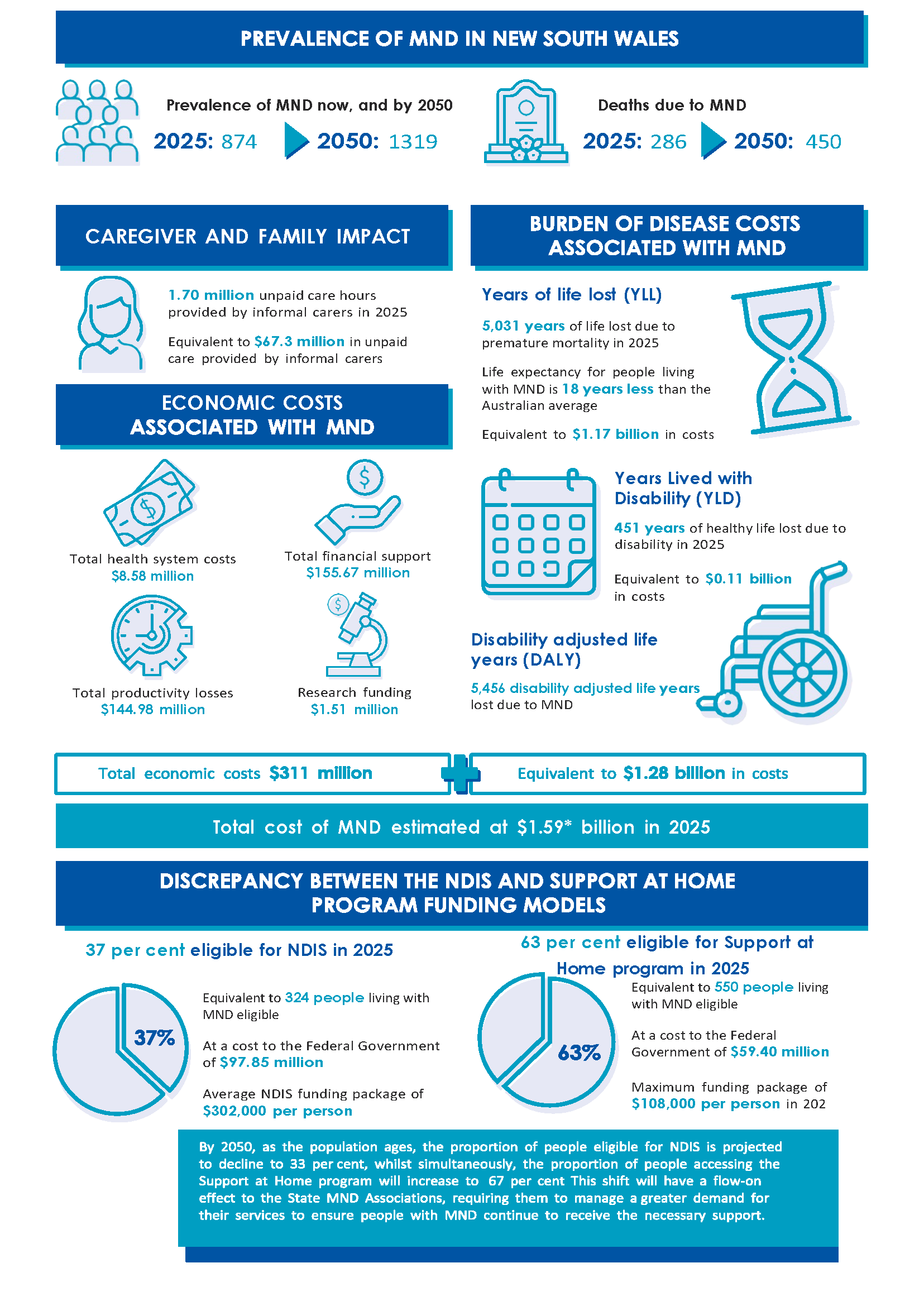
In NSW alone, the prevalence of MND is expected to increase by almost 51% by 2050, with over 1300 people living with the condition. As the population ages, the number of people eligible for NDIS funding is likely to decrease by 33%, meaning 67% of people living with MND will be accessing the Support at Home program to get the assistance they need.Currently 550 people with MND are eligible for the program, with maximum funding of $108,000 per person.
For those aged under 65, NDIS funding may be available - in 2025, 324 people living with MND were eligible, and on average the NDIS funding package was $302,000 per person.
During 2025, informal carers provided over 1.7 million hours of unpaid care to people living with MND, worth approximately $67.3 million.
Sadly, when a person is diagnosed with MND, their life expectancy is 18 years less than the Australian average, and in 2025 there was 5,031 years of life lost due to premature mortality.
In Australia, MND currently costs society over $5 billion each year, and is expected to grow to over $7.5 billion annually by 2050.
The report highlights the growing need for support for people living with MND, ensuring they get the care and treatment they need to maintain quality of life and spend as much time as possible with their loved ones.
Given these projections, it is likely more and more families will be reliant on the support provided by MND NSW, who help to close the gaps in funding support by providing
assistive equipment free of charge to people living with MND aged 65 and older.
Find out more, and access the Every Moment Matters report here.